



Penny Kim is a Sophomore and YEPT’s Colorado Director.
From piles of snow in Kentucky to a record warm winter in Colorado, the 2026 winter season has been abnormal across the United States. Meteorologists are still uncertain about the reasons for record low precipitation levels in the Western United States and the cooler-than-average conditions in the East. However, two definite factors are influencing the unusual weather, one being temporary weather patterns. The second factor — and the reason the warm and dry weather has been so extreme and pervasive — is climate change. Climate change is supercharging storms and producing more extreme weather patterns, affecting many recent extreme weather events.
Together, these climate change-related factors caused nine states in the Western United States to experience their warmest winters on record, exacerbating the precipitation drought.
Partly responsible for the lack of precipitation is the La Niña weather pattern. In a typical El Niño year, ocean water is pushed towards the United States and evaporates readily, due to warmer Pacific Ocean temperatures. The increased evaporation leads to more precipitation.
However, this year, under the La Niña pattern, the Pacific Ocean is cooler than average and there is less ocean water evaporating to create precipitation over the Western United States.
Further compounding the precipitation deficit, the West is currently undergoing a ridge weather pattern. Essentially, a ridge pattern forms when the polar vortex, a circle of cold wind, bends southward forming a U-shape. The region where the polar vortex bends south, called the trough, experiences the cold temperatures and wind from the polar vortex. The area outside the U where the polar vortex bends north is called the ridge. The polar vortex causes warm air to move north in the regions under the ridge pattern, which are thus left warm and stormless.
The current disruption in the polar vortex is causing most of the storms to miss the Western United States to the North and East, which are under a trough pattern.
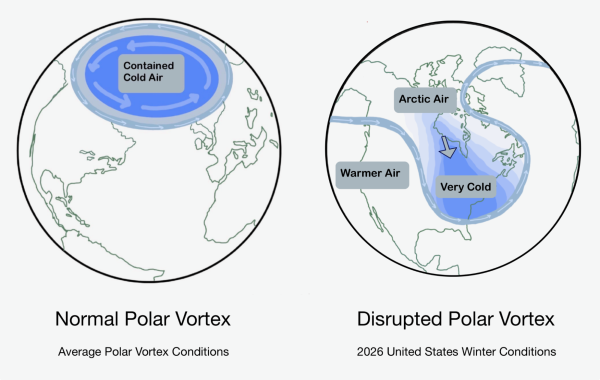
“When the West is warm, the East tends to be cold, and then vice versa,” Colorado State University Engagement Climatologist Allie Mazurek said. “That’s a pretty common situation.”
The ridge and trough weather pattern explains the cooler than average temperatures in the East, and the increased storms, which have caused confusion about the legitimacy of climate change.
“What’s happening on the day to day — the weather piece of it — gets confused a lot of the time for what’s happening over the long term with the climate,” Emily Danitz, AP Environmental teacher at Kent Denver School said. “We have to be really careful to differentiate those two things for people, so that it’s not confusing to them when you have a really cold streak or a really wet streak, and then people want to say, ‘look, climate change’s not real. It’s so cold right now.’”
Despite the colder temperatures in the Eastern United States, the overall, long-term trends verify that climate change is happening. Weather isn’t easily predictable nor linear, and oscillations like the cold and wet conditions in the Eastern United States are normal. The big picture — the global increase of two degrees Fahrenheit since 1850 — demonstrates that the planet is warming.
“In Colorado, specifically, we’ve seen out of that 135 year data set, eight of our 10 warmest years have occurred since 2012,” Mazurek said. “That’s definitely something that we can attribute to climate change.”
Excessive greenhouse gas emissions, produced from burning fossil fuels like oil and gas, trap heat in the atmosphere. Greenhouse gases, such as Carbon Dioxide, allow sunlight into the atmosphere, but once the light energy is converted into heat, greenhouse gases absorb heat and trap it in the atmosphere. This phenomenon, known as the greenhouse effect, has caused temperatures to rise to record levels.
These increased temperatures resulting from climate change have detrimental consequences, from wildfires to water supply, to natural disasters.
As a result of climate change, “we can certainly expect more extremes; more flooding, more drought,” Mazurek asserted.
Snowpack in Colorado represents around 80% of Colorado’s water supplies. However, due to the precipitation drought there has not been as much snow as expected. Furthermore, the snow that was received has melted due to warm temperatures. As a result, Colorado has only reached 55% of the expected and necessary snowpack.
“The Colorado River not only feeds our water [in Colorado], but it also feeds water in the whole entire southeast of the United States,” Danitz said. “So it’s a water problem all the way down to California.”
Another impact of the decreased snowpack is an economic downturn. For instance, in Colorado, a 20% decrease in skiers accounted for a 5.7% revenue loss for the resorts.
Skiing is hardly the only industry affected by a warming climate. Businesses like car washes and snow plow services are making a fraction of the revenue they would have in a year with more precipitation. Businesses that depend on water during the summer, like rafting, are also fearing the low precipitation levels.
Looking towards the summer, meteorologists predict intense temperatures, in addition to drought, raising health concerns for those who work and recreate outside, Mazurek explained.
Broad climate trends suggest warm winters like this are likely to continue happening in the future. Each community faces different, localized, impacts of climate change. Although winters in Colorado may look different than those in New York, the bottom line is the same: Climate change affects us all, in various aspects of life, and it has a myriad of detrimental effects.
Editor’s note: If you are interested in learning more about the polar vortex and the potential link to melting sea ice, consider visiting: https://www.scientificamerican.com/article/why-has-this-winter-been-so-cold-in-the-east-and-warm-in-the-west/ …as well as… https://www.climate.gov/news-features/understanding-climate/understanding-arctic-polar-vortex
The Science Behind the Record-Breaking Winter in the US © 2026 by Youth Environmental Press Team is licensed under CC BY-NC-ND 4.0. To view a copy of this license, visit https://creativecommons.org/licenses/by-nc-nd/4.0/