









This story was originally published in the ‘Harker Aquila’ on November 21, 2025, and we republish it here with their permission. Note that this story, from the Harker School in San Jose, is part of a series of stories spanning over nearly a decade, focused on human impact on the climate system.
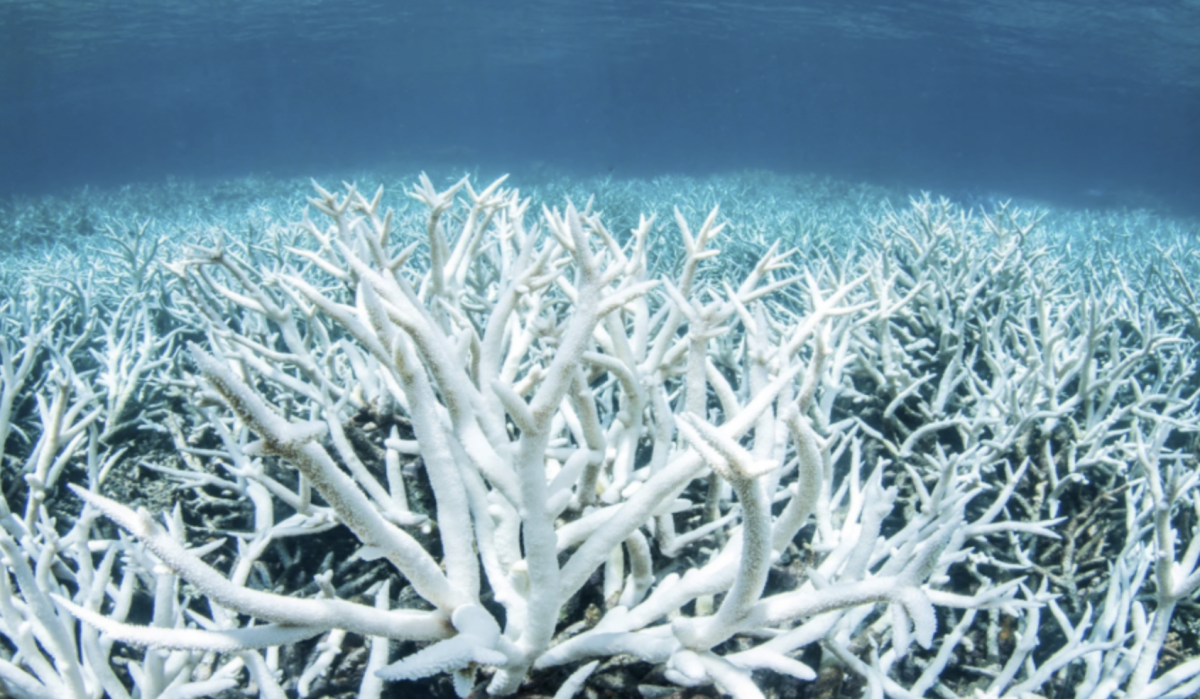
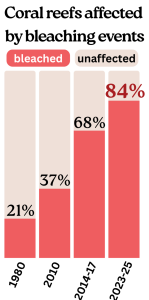
Coral reefs, which support 25% of marine life, currently face their largest bleaching event in history, marking the first time human-caused climate change has pushed an ecosystem to the point of no return.
With the increase of heat, even by a few degrees, coral undergoes bleaching when removing algae called zooxanthellae from their tissues. Thriving on a symbiotic relationship, these algae use photosynthesis to produce nutrients while offering corals their bright colors, so upon expelling the algae, the coral’s white limestone skeleton becomes visible.
“Once corals start to bleach, the whole ecosystem is destroyed,” coral and marine biology researcher Oskar Baumgarte (‘25) said. “Once damaged, corals take years to recover. With the coral that I sampled for my research, I cut small pieces of tissue out of it. It’s been a year and just now it’s fully recovered and growing bigger again.”
Seen as a climate change “tipping point,” researchers pinpoint that over 80% of coral reefs have been hit by extreme temperatures.
“Contrary to popular belief, corals are one of the most sensitive organisms in the ocean, more sensitive than fish,” Oskar said. “I used to have this small reef tank when I was in middle school, and one time I washed one of the tools I was using with soap, but not all the soap came off of it. When I used the tool in the tank again, the corals all died within a couple weeks.”
When coral becomes bleached, it disrupts the rest of the ecosystem as well. As coral become less colorful, the brightly colored fish that use reefs to hide from predators are also threatened. In fact, global bleaching events have decreased the coloration of fish in reef ecosystems.
Senior Victoria Ma conducted research on marine biotoxins and simultaneously learned about marine life. She emphasized the significance of coral in various ecosystems. “Coral reefs are one of the biodiversity hotspots on the entire planet, and they’re home to so many different species,” Victoria said. “Losing them would mean so many beautiful, colorful and diverse organisms losing their homes.”
The decline of coral reefs also threatens human lives. Coral reefs serve as natural barriers that protect shorelines from erosion and storm surges, and their loss places millions of coastal residents at higher risk of flooding and property damage.
They contribute 3.4 billion dollars of value to the US through fisheries, tourism and coastal protection according to AP Environmental Science teacher Jeff Sutton.

“Coral reefs provide protein for millions of people, support jobs in fishing and tourism industries, and protect coastal infrastructure worth trillions,” Sutton said. “Additionally, reef organisms have yielded treatments for cancer, arthritis, and other diseases — we’re losing a pharmaceutical library before we’ve even read it.
Additionally, coral loss affects the balance of marine chemistry. Healthy coral helps stabilize local pH levels and supports the organisms that depend on calcium carbonate to build their shells. When coral dies, however, their skeletal structures erode, reducing this buffering effect.
The large-scale bleaching and death of coral is one of many warning signs that the planet is under strain. While researchers race to restore coral through reef gardening, selective breeding and temperature monitoring, their efforts can only do so much without global change. Green Team Co-President Siddhartha Daswani (11) commented that the death of these corals reflect a larger disregard for the environment.

“[The situation] is a symptom of the way that we approach the environment in the sense that we don’t have regard for these things until they’re gone,” Siddhartha said. “Even though we might not be directly impacting corals, there are still things that we do that hurt ecosystems everywhere, so we have to pay attention not just to what we’re directly impacting but also beyond that and what could be impacted.”
Reducing carbon emissions, supporting sustainable tourism and advocating for ocean conservation all play a part in reversing this decline. Sutton also cites choosing sustainable seafood and using reef-safe sunscreen as often overlooked ways to help. Ultimately, the protection of our environment rests in our efforts toward sustainability.
“We need action at multiple scales — globally, nationally and locally,” Sutton said. “Time is critical. We’ve lost nearly half of the world’s coral reefs since 1950, but there is hope. Corals can recover, and innovative solutions like coral nurseries show promise. This is our challenge to solve.