








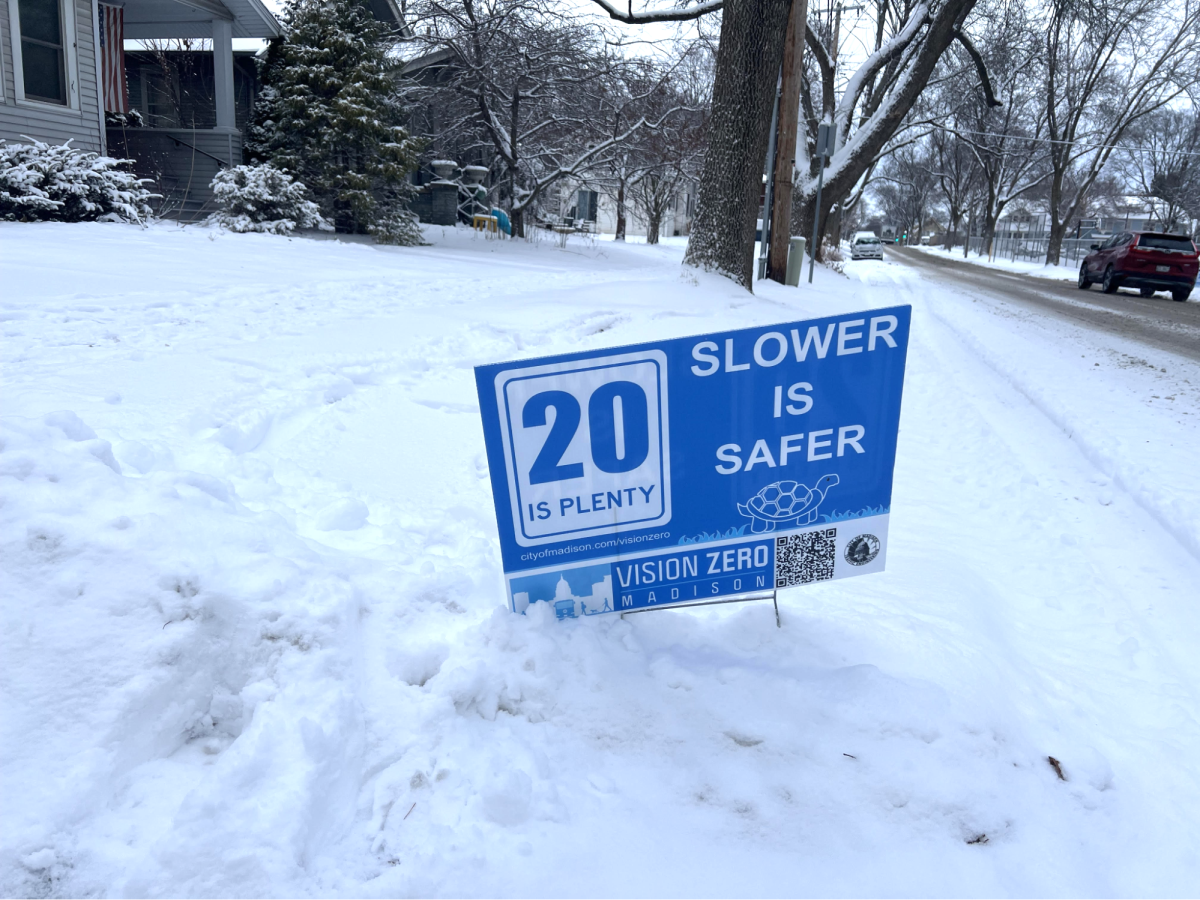
Driving down the tree-lined residential streets of Madison, Wisconsin, every other house seems to sport a yard sign that announces “20 is Plenty” or “Slower is Safer.” The yard signs are just a small physical marker of a worldwide campaign called Vision Zero. A many-pronged approach, Vision Zero aims to “eliminate all traffic fatalities and severe injuries, while increasing safe, healthy, equitable mobility for all.”
With its roots in Sweden, Vision Zero began as a small experiment in traffic regulation. Since then, it has spread to cities across the globe.
While the initiative’s primary focus is on eradicating preventable deaths, like many public health and social justice campaigns, it works hand in hand with the climate movement, inadvertently reducing greenhouse gas emissions and contributing to a more sustainable planet in the long-term.
One of Vision Zero’s primary tenets is a reduction in Vehicle Miles Traveled (VMT). This, of course, directly translates to a reduction in carbon emissions. Using cars less and driving shorter distances is one of the most effective ways for an individual to reduce their climate footprint.
Vision Zero does not force restrictive policies, by and large. While carbon taxes or laws around energy can be strikingly effective, they are also incredibly controversial. Instead, Vision Zero focuses on making the safer choice the path of least resistance. In Madison, for example, Vision Zero encourages cycling or walking in place of driving by making pedestrian and cyclist pathways safer and more visible. From 2020 to 2022, the city has built an additional 11.4 miles of bike paths and 6.2 miles of walking paths; added high-visibility blinking lights to busy crosswalks; and constructed midblock pedestrian crossings, according to the city’s impact report. A switch to LED lights contributed to better visibility for drivers while simultaneously supporting more energy efficient and longer-lasting technologies.
Although generally the project does not seek to force harsher laws, a core principle of Vision Zero is the reduction of speed limits, particularly in residential areas. When a vehicle drives more slowly, the likelihood of a serious crash drastically decreases as the driver gains better visibility and more time to react. Coincidentally, the consequent reduction in acceleration is more fuel efficient and better for the environment as well.
Another important aspect of the campaign consists of education campaigns, from World Day of Remembrance for Road Traffic Victims to a Safe Routes to School campaign. The city’s Transportation Department also makes a point of showing up at community events to engage with individuals about street design. As part of the Be Bright At Night campaign, they handed out bike lights on the streets to those cycling in the dark.
Will your city be the next to implement Vision Zero?
Write to your local politicians to let them know about the initiative and why it’s important to you. Even if your city doesn’t adopt the official branding and multi-faceted approach of Vision Zero, the implementation of even one crash-reduction strategy would contribute to a safer and more sustainable home for every denizen of your city.
Vision Zero: A Life-Saving Campaign, in More Ways Than One © 2026 by Youth Environmental Press Team is licensed under CC BY-NC-ND 4.0. To view a copy of this license, visit https://creativecommons.org/licenses/by-nc-nd/4.0/