




The author is a rising junior in Chicago, Illinois.
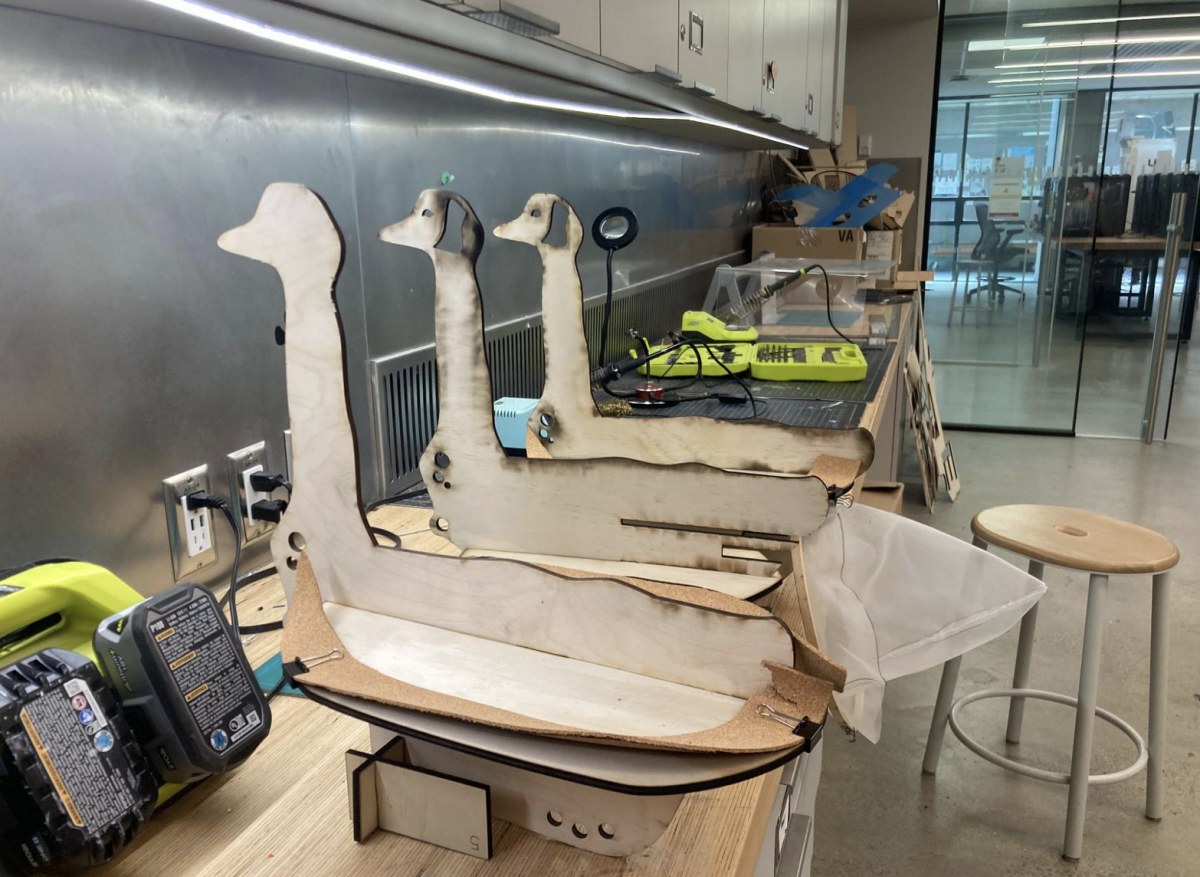
What happens when art and activism meet? School of the Art Institute of Chicago (SAIC) graduate Val Thompson developed a tool that collects microplastics in order to minimize pollution in waterways, most notably the Chicago River, called Gregory the Goose.
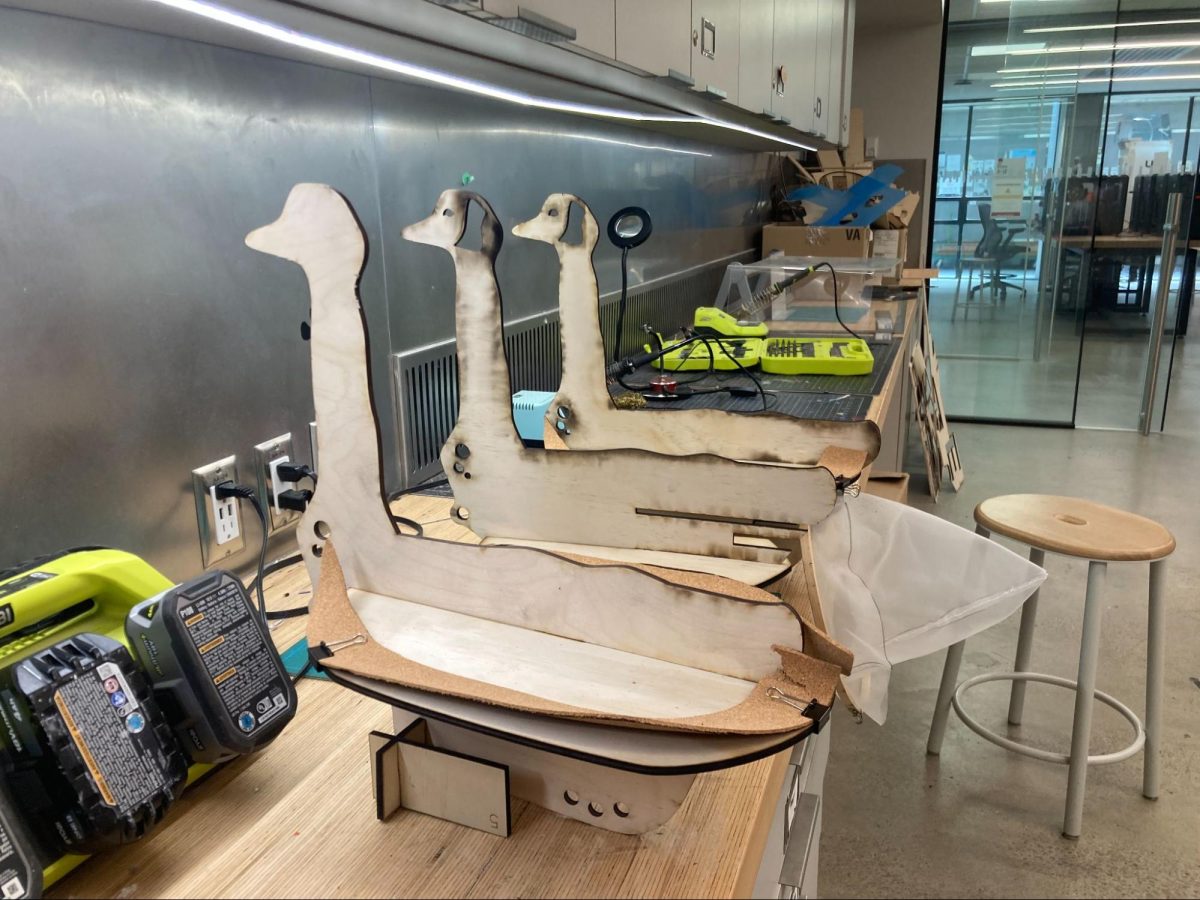
Gregory the Goose is a wooden sculpture with an attached net that serves as a filter. When a Gregory is put in the water, the net collects microplastics, effectively removing them from the water.
Developing Gregory
Thompson, a self-proclaimed lifelong learner with a passion for river ecology, began developing Gregory while studying at SAIC.
Having been a whitewater rafter and having witnessed drought and pollution as the result of a tech boom during their upbringing in Austin, Texas, Thompson became “existentially concerned with pollution.”
They took collaborator Sarah Rosengard’s class at SAIC, and from this came a creative partnership that saw the birth of Gregory the Goose.
“Iterative design is really important,” Thompson said of Gregory’s early days.
Thompson debuted their first microplastic-collecting sculpture at the Wild Mile, a floating eco-park spearheaded by the nonprofit Urban Rivers. From there, they presented the sculpture at the American Geoscience Union’s Ocean Science Meeting, Cool Science, and UMass Boston, and partnered with Friends of the Chicago River on River Day to test public engagement with Gregory.
Thompson described the first time they went to the Wild Mile with Rosengard to test a prototype as “so exciting and so terrifying all at once.”
Collecting Microplastics
Microplastic pollution is an omnipresent issue, especially in our waterways. The use of non-biodigradeable plastics is deeply intertwined in our everyday lives, from the clothes on our backs to the sunscreen we wear in the summer. The short lifecycle of such products means they are discarded frequently, and they often end up in rivers, lakes, and oceans. When consumers seek to replace those products, the cycle repeats.
At the Wild Mile, Rosengard and Thompson found a nurdle and other plastic bits.
“A nurdle is a microplastic that’s relatively large for microplastic, but it’s still under 5 millimeters,” Thompson said. However, “There aren’t manufacturing plants in Chicago. It’s just the wind, the weather, our ecosystem, pollution, the movement of people just moving all of this plastic around.”
With the collected microplastics, Thompson is developing a process to “capture everything and turn it into something beautiful.”
They have used the microplastics collected by Gregory in their studio to create materials and even sculptures and furniture using collected plastics. They do this by trapping the materials within a biological matrix, which contains the microplastics via organic materials that grow around the waste, absorbing it and creating a strong structure. As a result, pollution is “inert and doesn’t leech microplastics back into the environment,” Thompson said.
Not only does this process produce new art, but it also disrupts the cycle of microplastic pollution that results in, for example, a nurdle in the Chicago River.
Regarding the Gregory the Goose sculpture, it collects microplastics simply using an embroidery hoop and Nitex fabric, a material commonly used by scientists to collect microplastics and algae.
“Anybody with access to a laser cutter at Home Depot and that has the gall to, can make their own,” Thompson said. “I don’t believe in gatekeeping information, and this is a project that’s first and foremost about servicing community members. It’s about a collective action of mass organization through play for environmental stewardship. Open access is a fundamental tenant of this project.”
The Fusion of Art and Activism
It is simplicity, in addition to the whimsical nature of a plastic-collecting goose, that makes Gregory such a positive tool within the realm of environmental solutions. At times, people describe climate action as a chore, a great sacrifice, or inaccessible. While sometimes it is difficult to find means to take action, the great thing about Gregory is that using this structure to reduce pollution can be a fun activity for those of all ages.
Given that the future of the pollution cycle and how it is addressed lies in the hands of young people, tools such as Gregory are a great way to work activism into the lives of even the youngest children and can help introduce them to the issue of microplastic pollution without overwhelming them.
Whether a new form of play for a young audience, or a building project for an older one, Gregory not only brings people together, but is a way to incorporate activism into one’s schedule as something new and exciting.
“When you use states of play, you can speed that process up and make it enjoyable,” Thompson said. “Art makes change fun.”
On the fusion of art and activism, Thompson spoke specifically about where one can begin, and what that process looks like. As art was their initial inspiration to take environmental action, Thomspon recommends that anyone looking to use art as an outlet for activism to “get comfortable with stumbling and turn it into dance. I’d say iterative design processes are normal, and having a stress tolerance through uncertainty as you’re dealing with really weighty conceptual topics. Because art comes from emotions.”
Certainly, the state of pollution in our environment can be emotionally intense. And at times, it can feel endless, but any progress is still progress, no matter how small. Thompson said of uncovering microplastics via Gregory, that while terrifying, “the cool thing is that through the act of collecting pollution, we’re taking it out of our water,” which is always better than doing nothing at all. Gregory shows us the many outlets that art can provide for activists battling the climate crisis and provides a positive way to deal with a negative issue.
Get Involved!
“I would love to see Gregory the Goose as a scaled system that anybody can use, check out, or purchase in order to collect citizen science as an activity,” Thompson said. In the spirit of open access, even without access to the tools required to build your own Gregory, you can “get a filter and clean [microplastics] up,” or “take a sieve to [water].” That being said, you can make your own Gregory by simply contacting Val Thompson at [email protected] for a file and begin collecting microplastics!
Gregory the Goose: A Simple Structure Tackling Microplastic Pollution © 2026 by Youth Environmental Press Team is licensed under CC BY-NC-ND 4.0. To view a copy of this license, visit https://creativecommons.org/licenses/by-nc-nd/4.0/