





The author is a rising senior in Mt. Pleasant, South Carolina.
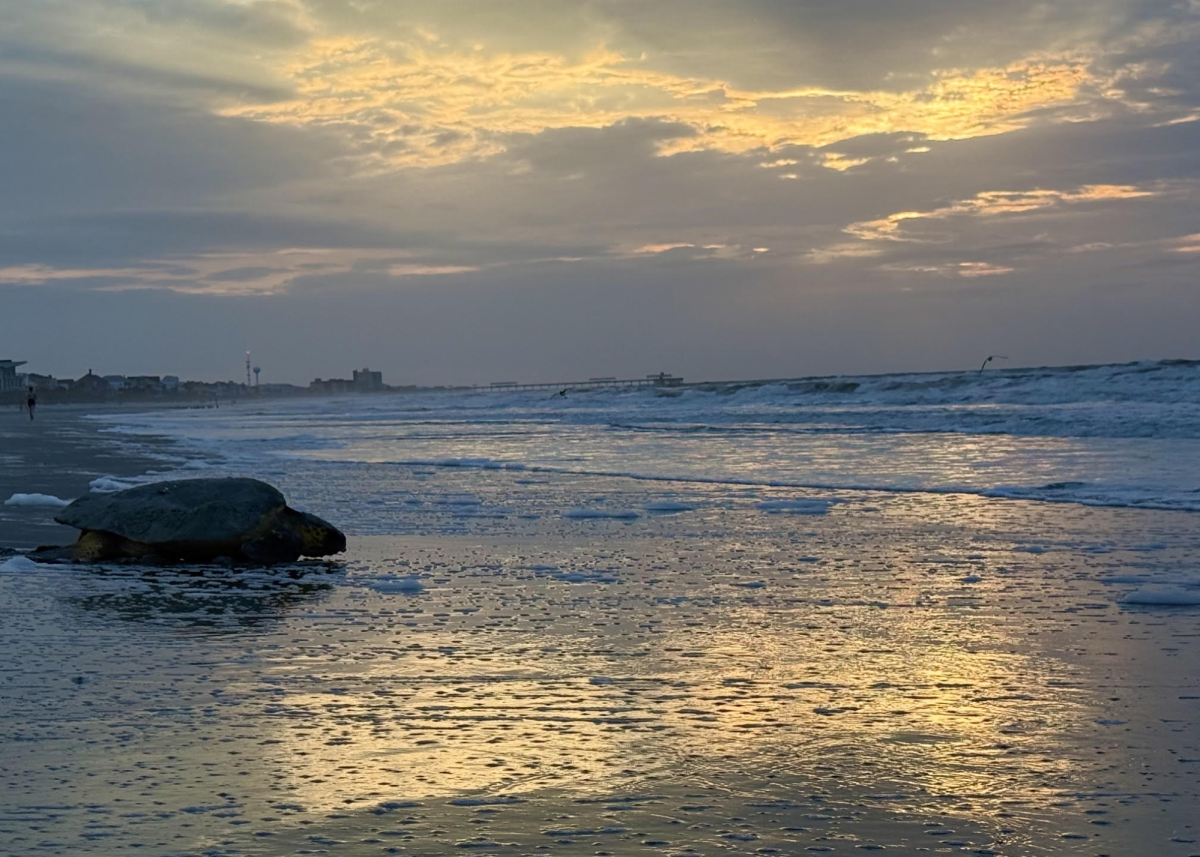
As oppressive heat bears down on the southeastern United States, millions of people flock to the beaches for a bit of relief. They are joined in their migration by reptilian companions; sea turtles, who lay over a hundred thousand nests along the tourist-packed coast.
The city of Charleston, SC, popular for bachelorette parties and history buffs, is one of many coastal regions that must play the game of balancing increased human activity with the protection of the oldest marine reptile.
The Folly Beach Turtle Watch Program, permitted under the Department of Natural Resources (DNR), aims to combat human impact on turtle nesting and hatching. Section Leader and Board Member Kristin Kappel has been a part of the watch program for seven of its 33 years, returning each summer to locate and assist nests.
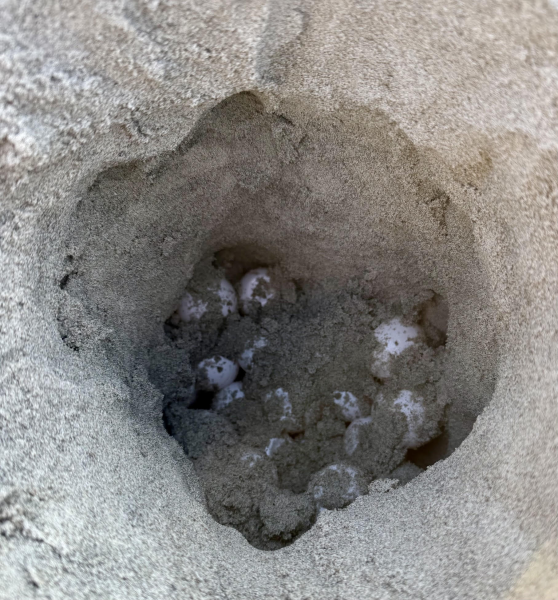
“[Sea turtles] come up on the beach during the night and bait their nest and lay their eggs,” Kappel said. “The mama turtles leave, and they never meet their baby. And then the hatchlings actually emerge almost always overnight as well. And so we get out there before the crowds and before ATVs and chairs … and go check the whole entire beach, looking for the crawl of the mama … and then once we see that, we investigate the area, determine if there is a nest.”
Once a nest is laid, it requires about 60 days of incubation before hatching. However, the eggs themselves can offer valuable insight. Using a long, thin probe, the turtle watchers take one egg from each chamber.
“We sacrifice an egg as a part of a much greater research project that DNR is doing nationally,” Kappel said. “The DNA from the mother is in the eggshell, so we harvest that one egg, empty the yolk, and then actually save that eggshell in a little vial of alcohol. We send it off to DNR, who sends it to the lab, and we get all this great research and data out of it. You can tell who the mother is, how often she’s laid, how successful her nests are.”
Locating the nests allows extra precautions to be taken as hatching season (July-October) approaches. One of the largest threats in this time is the use of artificial lighting in coastal towns. While some places, like Folly Beach, have ordinances against beachfront lighting after certain times, stray porch or pier lights remain a danger to turtle hatchlings.
“Sea turtles … can be distracted by those lights and just abort their nesting mission … but the worst part is that hatchlings actually go to the brightest light they can see when they emerge from the nest, and in the absence of humans and all of our commercial activity that’s happened over many, many generations, the brightest light was a reflection of the moon on the water, and so they just naturally … know to go to that brightest light, and it drives them straight to the ocean,” Kappel said.
Even when these artificial lights go out, other human-made obstacles, such as holes or litter, remain. Various organizations, including the Isle of Palms (IOP) Cleanup Crew, work to combat these threats.
Charleston County eighth grader Camilla Stephenson is a frequent participant in the IOP Cleanup Crew’s beach sweeps, and holds her local environment in high regard. Partnering with the South Carolina Aquarium, the Cleanup Crew tracks the litter collected in order to better understand how to combat the issue.
“[Sea turtles] can eat the litter … because they think like they’re jellyfish or like food for them,” Stephenson said. “Since we found out how much … cigarette butts have been … affecting the environment, we got a cigarette ban on the beach.”
Community-members like Stephenson and Kappel aim to make an impact, no matter how small, for the greater good.
“I’ve seen baby sea turtles before … they were very cute, and I couldn’t imagine … them, like eating trash,” Stephenson said. “If everyone does their part in helping … we could have a very clean environment … for everyone.”
The appeal of a coastal city attracts turtles and tourists alike, but the two do not necessarily have to conflict.
“Tourism is a pro and a con, right? The more people on the beach, the more hazards there are to the endangered species,” Kappel said. “At the same time, the more people come and actually learn, the more future conservationists, and the more conservation efforts the public can do as well.”
As of October 2025, the green sea turtle is no longer considered endangered. This is a testament to the organized efforts of conservationists and individuals who cared enough to make their own impact. However, five out of the seven species of sea turtle remain endangered, and their only hope of improvement is human responsibility for human impact.
“Only one in 1000 sea turtle hatchlings will survive to reach reproductive age,” Kappel said. “If today I was able to help one, then I’ve done a good job, and I would say to anybody that you don’t even know how you’re making an impact. You fill your hole when you leave the beach, you likely could have just saved the entire nest, actually, from getting stuck and not even knowing.”
“Sea Turtles Hatch Into A World Rigged Against Them” © 2026 by Youth Environmental Press Team is licensed under CC BY-NC-ND 4.0. To view a copy of this license, visit https://creativecommons.org/licenses/by-nc-nd/4.0/