
The author is a high school senior in Missouri and a Director for YEPT. Note, once a month, YEPT invites professional journalists to talk with students about their career path as well as answer questions.
Climate Journalist Jason Margolis is a seasoned reporter with over 20 years of experience including the radio program, “The World,” which was a co-production of the BBC World Service and GBH in Boston. Currently he is the Climate Science and Transportation Editor for the Boston Globe. He met with the Youth Environmental Press team April 8, 2026, via virtual meeting, to discuss his career and answer questions for the staff. The following is a transcript of the Question and Answer session with Margolis, providing powerful insight into the future of journalism.
YEPT: How did you get your first journalism job, and how did you land in climate?
Jason Margolis: So I got my first journalism job just by dumb luck. I went to one of these job boards right out of college, and I got a job at CBS Sports. I was a researcher at the Winter Olympics, and the job of the researcher is… it’s a room filled with young people in their 20s. And when you hear the anchor Jim, it was Jim Nance at the time, saying some incredible fact about an athlete, it’s because a 23 year old went out and talked to that athlete. So that was my first job, and I really liked it, but I wanted more experience. So I went back and I got a master’s at UC Berkeley. I had met Al Gore, and then just more and more I learned about climate change. It was like, what kind of world are we leaving to our grandkids? And I thought it seemed like a worthwhile thing to dedicate my time to do.
YEPT: How can you incorporate multimedia to draw people into articles?
Margolis: I think photos and short videos are great. I’m a reader. We’re part of a dying breed. People like to consume their news or information visually. AI is a good question. I mean, it’s so quickly evolving, and we just had a meeting in our newsroom, and someone asked the editor-in-chief what we were doing about AI, and he was stumped. He said, I don’t know. We’re trying to use it to make our jobs easier and our product better, but it’s so quickly evolving, and it’s scary too, because you don’t know where it’s going. So I think we’re all on this roller coaster, and we just got to strap in and have faith. But it is very frightening. I have friends who work in the field who are very pessimistic about it, and then I have friends in Silicon Valley who think it’s going to transform the world for the better.
YEPT: What skills do you think it’s important to have right now as a student who’s entering journalism in the age of AI?
Margolis: AI can be used to do a lot of research very quickly, So whereas maybe it took a team of people look through documents, you can do that in a nanosecond now. So I think that’s okay, and it frees us up to do more work. We don’t use it to create headlines, but we let it spark ideas. So I put in my story, and it spits back five suggested headlines. Sometimes I know those five are not good. I’ll stick with the one I wrote. But sometimes I look and go, oh, I like number one and number four. What if I mesh them together? So it’s just a way to get you thinking.
When I started in radio in 1998 I was an intern at NPR, and we were using actual physical tape and razor blades and grease pencils. So you would listen to the tape, and then you put a little grease pencil mark where you wanted to end the quote, and then take the razor blade, and you would slice it, and then you would grab the other quote, and you would put it together with a piece of tape. It’s crazy. Then we got things called mini discs. I don’t know if you know what those are, but they’re basically small CDs that you could record on. So then I’m holding in my hand this big, clunky machine that was just an SD card.
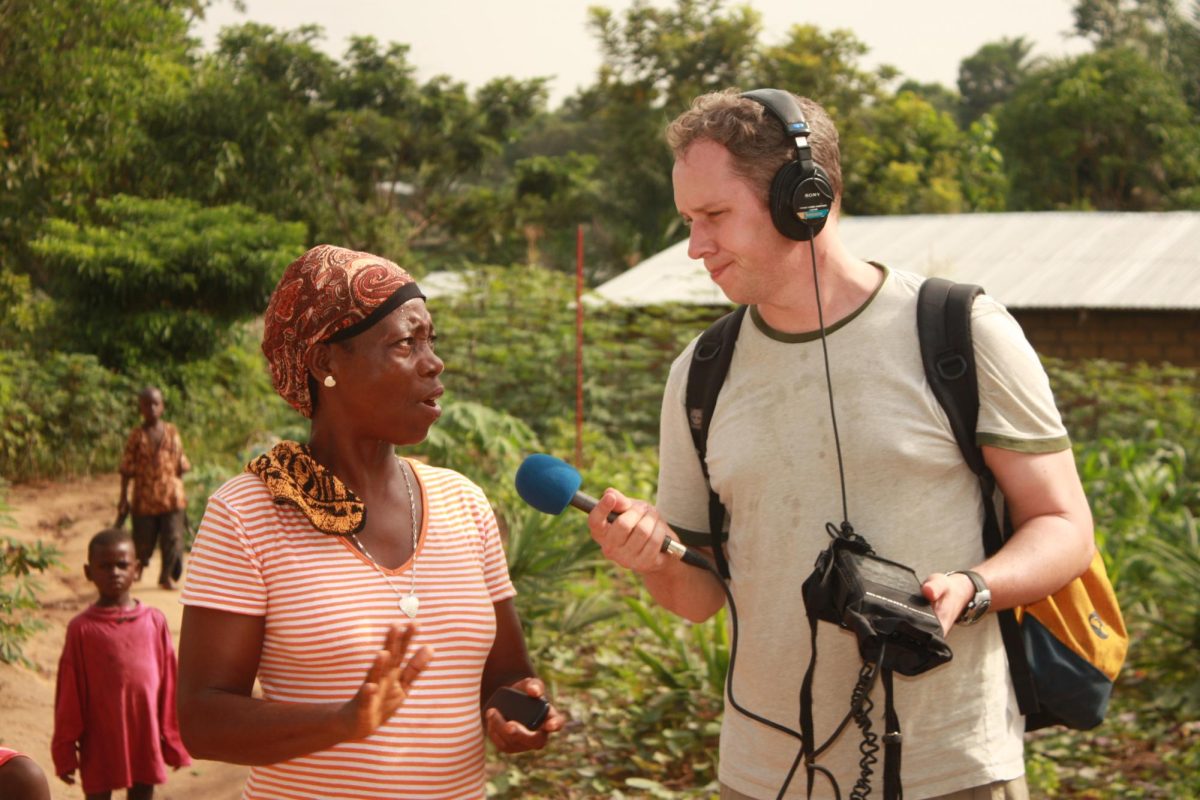
I was in Liberia, Africa [see photo, above]. There I go on a two week assignment. I come home and just listen to all my tape, and then I would, you know, transcribe it. And it would take me a long time, days and days and days, sometimes over a week. It’s pretty boring, but you go back and you listen to your story, and you look for quotes, and you start to understand what your story is.
Now reporters, they just come back from the field, they pop it in and the AI machine spits out a transcript in seconds. So it has made life easier. What I’m saying is technology makes our lives easier and easier and easier, but it also is scary. Change is always scary, but I think you have to embrace it. I don’t know if you know the term Luddites, it’s an expression for someone who doesn’t embrace change. The Luddites were actual people who went in and they destroyed machines.
I would advise you to not be a Luddite and learn as much as you can. And you’re young and you’re adaptable, so you have a big advantage over someone who’s already 30-40 [years old], I’m a little worried about them. I have about maybe 10-15 years left to go in my career. I’ll be okay. But you guys are learning this new stuff in college, so you will be okay.
YEPT: How do you balance telling hopeful or human focused stories without sugar coating the really important facts?
Margolis: Yeah. I don’t think you sugarcoat things. You tell people the way it is. But I don’t know if you have ever seen, going back to Al Gore, his movie An Inconvenient Truth? It’s probably 20 years old now, over 25 years old, and a lot of people didn’t know about climate change. This was their introduction to climate change. It is depressing as hell, because he’s just outlining how the world is going to be destroyed, and then in the last five minutes, he brings it back, like, wait a second, there’s things we can do. And then you feel this sense of empowerment and hope. And I always think about that in my story, it’s like, I’m not making a documentary that tens of millions of people are going to see. I’m just editing or writing a story that a few thousand, or maybe tens of thousands of people will read. But I think you always have to give people a little bit of hope, and that doesn’t mean you don’t tell them what’s going on, but if you just bombard them with negative, negative, negative, they’re gonna stop paying attention. They’re gonna throw up their hands like, well, what can I do?
YEPT: So when you’re writing an environmental article and you’re trying to find the best approach to it, how do you determine whether it’s best to use scientific data or the lived experiences of people who have been directly affected by it?
Margolis: So the classic journalism model would be to use both, right? You want to find an example. You want to use the scientific data as the base for your story, and then have people to make the story come to life. So that’s the classic way to tell a story. Sometimes you have better real life examples and less data, and sometimes you have more data and less real life examples. The reality is, if your editor says, I need that story by 4 pm you go with what you got. If you’re writing a story the editor gives you weeks and weeks to do it. You can find both. So those are the demands of the job if you continue on in journalism.
YEPT: What would be your advice to people looking to be more involved with the climate crisis, people who are looking to make a change, but they don’t know where to start?
Margolis: I mean, I think you have to figure out who you are. That’s what’s great about college, you can figure that out. I realized that I’m not the kind of guy who’s going to chain myself to a tree. This is not my personality, but I like to talk to the guy who’s chaining themselves to the tree and share their story. There are some people who work within the halls of government, and they realize they’re really good working within the confines of society. They can put on the suit and they can get things done that way. I’ve met some amazing environmental lawyers, if I had to do it over again, you know, these environmental lawyers can really, really, really impact change. A law degree is very powerful, and you can use it for good.
So there’s lots of ways you can help attack the climate issue. I thought about being a climate scientist, but then I thought, we have a lot of climate scientists, and I like telling stories so that’s the path I took. But I think you don’t have to figure that out tonight. You don’t have to figure it out next year. Your teenage years or 20s are for figuring out who you are and what you want to do, and hopefully that evolves through your whole life.
Q&A With Boston Globe Climate Editor Jason Margolis © 2026 by Youth Environmental Press Team is licensed under CC BY-NC-ND 4.0. To view a copy of this license, visit https://creativecommons.org/licenses/by-nc-nd/4.0/