








The author is a junior and YEPT’s Indiana director.
Do you have a light outside your house, a lamppost on your street, or leave the porch light on at night? All of these contribute to the growing problem of light pollution. Light pollution is the excessive or misdirected use of artificial lighting, and it has significant impacts on our environment, health, and the night sky. When was the last time you saw a star? Most of us have noticed the diminishing visibility of stars due to light pollution. In suburban areas, we could potentially see stars clearly if not for the interference of artificial light. Not only does light pollution affect our star visibility, but it also impacts humans.
Our bodies rely on natural light patterns to regulate circadian rhythms, which control melatonin production and other bodily functions. Exposure to excessive artificial light at night disrupts these rhythms, often disrupting our sleep and eating schedules. Beyond human health, light pollution also disrupts entire ecosystems. Nocturnal animals, which depend on darkness for survival, are pushed from their natural habitats, leading to population declines and, in some cases, extinction. As you can see, light pollution has crept into the lives of animals, humans, and entire ecosystems as a result of human impact, otherwise known as anthropogenic change.
Light pollution has been developing since the beginning of human innovation, notably through Thomas Edison’s invention of the light bulb in the late 1870s. However, the first substantial attention to light pollution was in the late 1970s, with research done by Kurt Riegel. While many trace the origin of light pollution to the start of agriculture, it was significantly heightened by the mid to late 1800s. The proliferation of light pollution in the United States can be traced from the early 1800s to the present through the use of media, specifically paintings and photography.
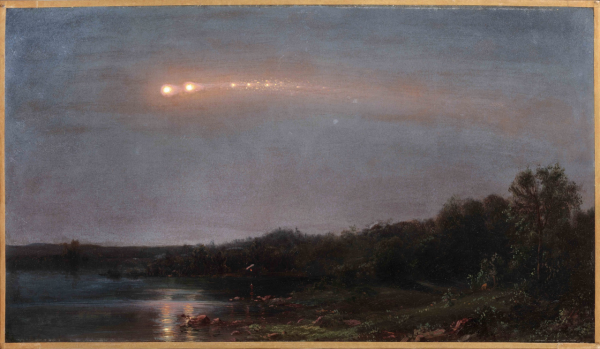
The 1860s were a period without artificial lighting, given that it was before the invention of the incandescent lamp. So, people in the United States relied on traditional lamp lighting to go about their everyday lives. Instead of flipping a light switch to get ready in the morning, they lit a candle to lead their path. The Reconstruction era (post-Civil War) of the United States suffered a strain on innovation without artificial lighting, but it was simultaneously captivating because light pollution had yet to make a major impact on animals, humans, and star visibility. As you can see in this painting by Frederic Edwin Church during the 1860s, above, there was a clear ability to view stars and meteors in even the most populous cities. Even more, this painting was based on a sighting in Caskill, New York, a few hours outside New York City, one of the most light-polluted cities in the modern United States. Therefore, the impacts of light pollution were not severe in the 1860s.
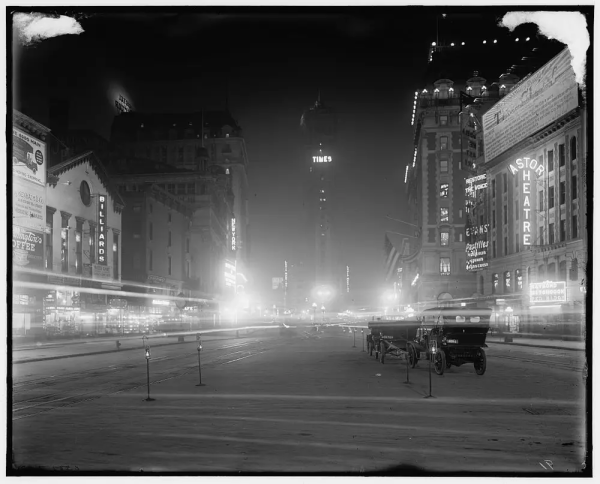
The light bulb was created during the Gilded Age of America in 1879. Thus, the amplification of light pollution in the United States can be traced back to the period of 1870-1900. To examine the impact of artificial lighting, this image from 1900 illustrates the proliferation and impact of artificial lighting in the United States, in just the 20 years since the incandescent lamp was invented. It is easy for one to be distracted by the bright lights, the tall buildings, and carriages within the image, but when you shift your glance to the sky, it tells a different story. The sky is devoid of any stars, meteors, or activity as a result of immense light pollution. The massive amount of artificial lighting present in New York City created skyglow, where the lighting infiltrated into the skyspace, shielding the visibility of stars. This can be shown when looking at the center of this image, focusing on the trespass of light vertically into the sky, and an abrupt shift into a darker atmosphere. Light pollution began growing briefly after the introduction of commercial artificial lighting, so the presence of light pollution has only exponentially grown as time passes.
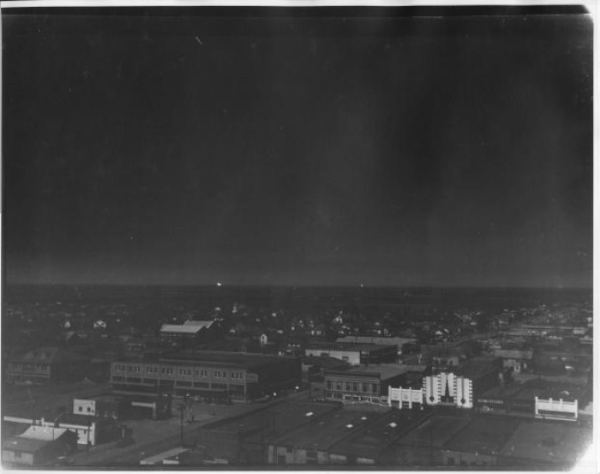
Moving from a bustling city scene in New York City to a rural area in Texas, there is still increasing evidence of light pollution present in the United States in the 1940s. After having over half a century to develop, there was a visibly larger amount of artificial light being used in the United States during this period. It was during this time that outdoor residential lighting, factory lighting, and more organized lighting came into use. Artificial lighting was no longer for the wealthy, businesses, or government; it was of widespread use. Even more, during the 1940s, the Rural Electrification Act was enacted. This Act allowed federal funding for electricity to expand to the rural areas of the United States. While this Act increased the availability of artificial lighting, it also began a period of increased light use, which in turn generated light pollution.
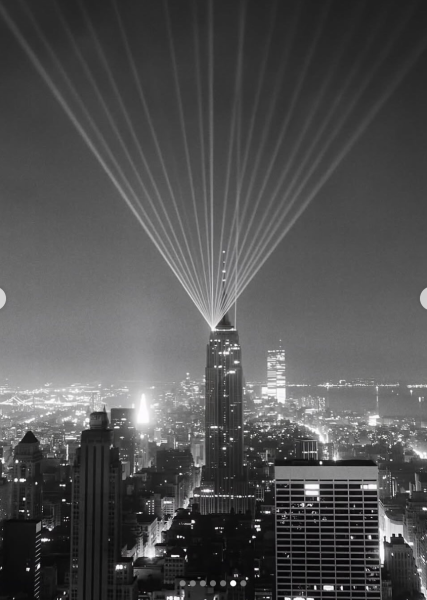
Moving into the 1980s, there was even more widespread artificial lighting use. This image depicts New York City emitting a large amount of light into the sky, causing skyglow and light trespass. While this is one of the most populous and dense cities in the United States, it is an effective marker of artificial use. It can be assumed that New York City was one of the most light-polluted cities in the United States at this time. Not only was the city emitting so much light that there was a lack of star visibility and the presence of a “haze” above the city, but also, there were rays of light being directly released into the sky. This image illustrates a shift from the 1900s image of New York City, as the city is noticeably brighter, and light pollution levels increased.
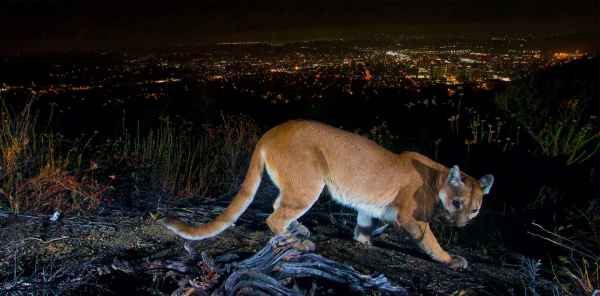
In the 21st century, it is important to review the use of artificial lighting in the modern day. As you might expect, it has risen even more. With new types of lighting emerging on markets, such as LEDs, it is to be expected that there is an increased implementation of outdoor lighting, as you can see in this image, which overlooks the Los Angeles skyline; the city masks all views of stars in the area. Even more, the orange layer directly above the skyline is visible as skyglow. Light pollution is only increasing as cities develop, new light fixtures hit the market, and more building projects go unreviewed by lighting committees. The artificial lighting from cities and urban areas is reducing star visibility, but also endangering wildlife species. Animals are often “lured” by lighting to new, unfamiliar areas, which disrupts the natural selection process and puts the animals themselves in danger. In addition, artificial lighting is also harming humans in the modern day, with people having a difficult time sleeping as light trespasses into their homes.
This article has outlined the evolution of light pollution in the United States, from the 1860s to the 2020s. While artificial lighting is an innovative wonder, it also has negative societal and ecosystem implications by disrupting animal life and human sleep patterns. It is easy to feel discouraged by the harmful impacts of light pollution, but you can help mitigate light pollution by taking simple actions, such as installing timers on your lighting, dimming existing lights, using motion-sensored lighting, or using downward-facing fixtures. These small changes reduce light trespass and minimize glare, making a significant difference in the fight against light pollution. If you are interested in learning more about light pollution, consider visiting https://darksky.org/
The Evolution of Light Pollution in the US © 2026 by Youth Environmental Press Team is licensed under CC BY-NC-ND 4.0. To view a copy of this license, visit https://creativecommons.org/licenses/by-nc-nd/4.0/


Clarke Kahlo • Mar 17, 2026 at 10:37 am
Terrific essay on light pollution. It’s one of my pet peeves and I’ve read several books and numerous essays about it. Even battled it in my neighborhood. Hats off to Ms. Pai. (I’m a 1966 alum of Park School which merged w/ Tudor Hall in about 1970).