
This story was originally published in the ‘Harker Aquila’ on February 17, 2026, and we republish it here with their permission. Note that this story, from the Harker School in San Jose, is part of a series of stories spanning over nearly a decade, focused on human impact on the climate system.
The U.S. Drought Monitor reported that California is drought free for the first time in 25 years this January, and is experiencing zero levels of abnormal dryness. Additionally, wildfire risk has reached a historic low and 14 of the 17 major reservoirs in the state were at 70% capacity or higher in January.
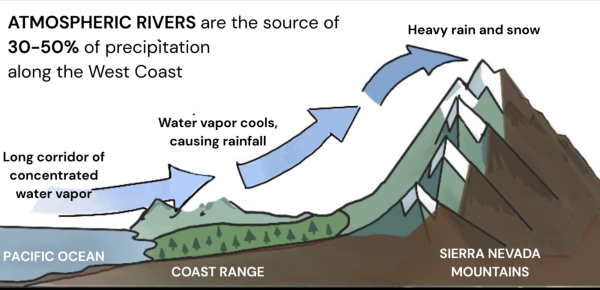
In recent years, drought patterns have changed dramatically as California has experienced a series of intense storms known as atmospheric rivers. These are long, narrow bands of moisture from the Pacific ocean that can release days’ worth of rain and snow in a short period of time. Intense storms have helped refill reservoirs and build up snowpack, pushing the state out of drought conditions.
California’s climate has historically made water scarcity a significant challenge. The state receives little rainfall relative to its large land area, and much of its water supply depends on seasonal snowfall rather than consistent rainfall. When dry years last longer, such as the 6 year 2011 drought, water stored underground and in reservoirs can deplete quickly. AP Environmental Science Teacher Jeff Sutton noted that dry periods lead to increased wildfire risk.
“Long-term drought would mean more fires, probably bigger fires — more frequent and more intense wildfires,” Sutton said. “That affects plants, bacteria, fungi and all the organisms in that ecosystem, and in the short term it can be catastrophic for the environment.”
California’s location along the Pacific Ocean plays a major role in shaping these conditions. The ocean current cools the air, limiting the amount of moisture in the atmosphere and reducing overall precipitation.
Even with recent increases in rainfall, many problems caused by long-term drought take longer to reverse. During drought years, people turned to groundwater which takes longer to refill than rivers and reservoirs. Sutton emphasized that overusing this supply can cause significant challenges such as wildfires and environmental destruction.
“Water is precious, and we should still be conservative,” Sutton said. “If we just start using it without regard for sustainability, we’re going to be right back where we were. Even if we have more water now, that doesn’t mean the problem is solved.”
In recent years, California has been experiencing rapid climate change, causing unpredictability in weather patterns with extreme drought from 2011-2017, heavy rainfall in 2022 and 2023, and exceptionally dry conditions in 2024 which led to wildfires in 2025. Excessive rain leads to vegetation growth, which feeds large fires.
Green Team member Ishita Konakanchi (10) noted that the unpredictability of recent years stems from overall global warming caused by burning of fossil fuels that heats the atmosphere, the effects of which are especially seen in big cities. She emphasizes that students should be more involved in climate action to benefit their communities.
“The climate is really unpredictable, and rain patterns have been changing,” Ishita said. “That’s just evidence that we need to take action, and if we don’t, nothing can be fixed. Drastic change won’t happen overnight. It has to happen over a couple of years, and hopefully people will realize that something’s really wrong.”
Ishita said that one important step is voting for representatives at the local, state and national levels that prioritize climate policy for a greener future and efforts to reverse global warming.
As California enters 2026 free of drought conditions for the first time in decades, experts caution that the relief should be seen as temporary. While heavy storms have reshaped the state’s immediate water situation, California’s long-term stability depends on careful water management, continued conservation efforts and preparation for an increasingly unpredictable climate.
Global Reset: Drought-free 2025 Marks Milestone for California © 2026 by Youth Environmental Press Team is licensed under CC BY-NC-ND 4.0. To view a copy of this license, visit https://creativecommons.org/licenses/by-nc-nd/4.0/