










The author is a Senior at Bellevue East High School in Bellevue, Nebraska, and a Director for YEPT.
Meteorology was always a part of life for Bellevue West High School Senior Madalyn Croteau.
As a kid, she would stand outside observing the weather for hours until her mom dragged her inside. When she got older, she considered studying meteorology at the University of Nebraska-Lincoln (UNL).
But when UNL eliminated its Earth and Atmospheric Sciences (EAS) Department, her plans changed. Croteau is now enrolled at UNL as an English major.
“UNL was always my number one goal,” Croteau said. “It was always my plan to stay close to home due to the financial aid I would receive and the distance to my family. Even when the programs got cut, I just switched my major instead of colleges.”
The elimination of the EAS Department was set in motion three years ago due to state tax cuts. Lower tax revenues led to a multimillion-dollar state budget shortfall. In 2025, the state legislature increased funding for the Nebraska University (NU) system by 0.625%, well below what administrators said was needed to match rising costs. Former UNL Chancellor Rodney Bennett, proposed cutting several departments, including EAS, to decrease the deficit.
“ It’s so odd because I [did] weather camp [at UNL] for four years and so we always toured the department and always had professors come and talk with us,” UNL freshman Lizzie Aurit said. “I’ve always had this picturesque vision of what the department’s supposed to… be like… then we get slated to get cut and then the whole tide changes, everything feels weird.”
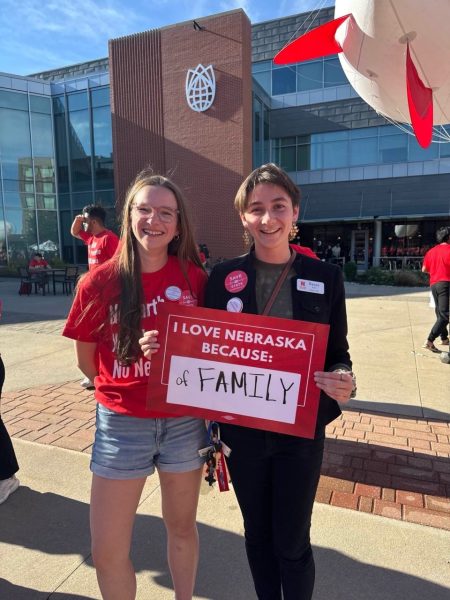
The EAS Department was eliminated on December 5, 2025 with a 7-1 vote by the University of Nebraska Board of Regents. The Board did not respond to requests for comment from Youth Environmental Press Team. The decision was partially based on the fact that EAS had fallen below degree-earning metrics from the Nebraska Coordinating Commission for Postsecondary Education. EAS faculty, however, noted that the meteorology, climatology, and geology programs offered within the department are the only ones of their kind in the state.
“For atmospheric sciences, we’re the only degree-offering program anywhere in the state,” EAS Department Chair Clinton Rowe said. “We’re the only department in the state that offered degrees at the graduate level, so critical for the graduate education for people who want to go into professional degrees in meteorology and geology.”
EAS was also a major driver of climate research in Nebraska. Multiple department faculty contributed to the 2024 Nebraska Climate Impact Assessment Report, and an EAS study that concluded in February 2025 discovered new sources for sustainable bioenergy.
“Without a degree program in these areas, it’s going to be difficult to attract students to do that research,” Rowe said.
Additionally, Rowe says that elimination of meteorology studies will lead to fewer trained meteorologists in Nebraska. Aurit believes the same.
“People who are interested in weather have to go to other schools and then they’re probably going to end up in a different area, a different state,” Aurit said. “You just kind of have a lot of people who aren’t from Nebraska talking about Nebraska weather, and you lose that touch of… hometown care.”
Nebraska also faces extreme weather like droughts and severe thunderstorms. July 2025 alone found over 100 wind and 70 hail reports across the state. Nebraska climatologists note that such severe weather has increased over time due to climate change.
“Nebraska [is] a state that’s very prone to severe weather, and we’ve seen that, and people have died from severe weather,” Aurit said.
Despite the increase in extreme weather, meteorology research programs have been facing cuts across the country. For example, President Donald Trump proposed eliminating research by the National Oceanic and Atmospheric Association and dismantling the National Center for Atmospheric Research in Colorado.
“Nationwide, there’s a big take towards cutting meteorology and atmospheric sciences,” Aurit said. “Just anything related to climate change.”
Despite the elimination of the EAS Department, Aurit and Croteau both plan to stay at UNL. Aurit said that she was promised the ability to finish her degree at UNL and plans to go into graduate school after earning her bachelor’s. Croteau has changed her career goals from becoming a meteorologist to entering the publishing field.
“It was heartbreaking for sure, but I knew there wasn’t really a chance for me to follow through with that dream [of pursuing meteorology],” Croteau said. “As someone who is in love with weather, it does hurt to see the fields and careers surrounding it getting a lack of care and thought.”
Some EAS faculty may stay at UNL in alternative positions. The elimination of the Earth and Atmospheric Sciences Department affected 22 faculty and 117 students, ending major climate research programs and saving UNL $1.85 million. But for Rowe, the effects of the cut go beyond monetary value.
“I’ve devoted 40 years of my life to the University of Nebraska, and to the atmospheric sciences here, and to see that go away is just appalling,” Rowe said.
University of Nebraska-Lincoln Eliminates Climate Studies Department © 2026 by Youth Environmental Press Team is licensed under CC BY-NC-ND 4.0. To view a copy of this license, visit https://creativecommons.org/licenses/by-nc-nd/4.0/


Isaiah Samuel perry • Jan 29, 2026 at 5:16 pm
I agree