




The author is a high school senior at the Michigan Director for YEPT.
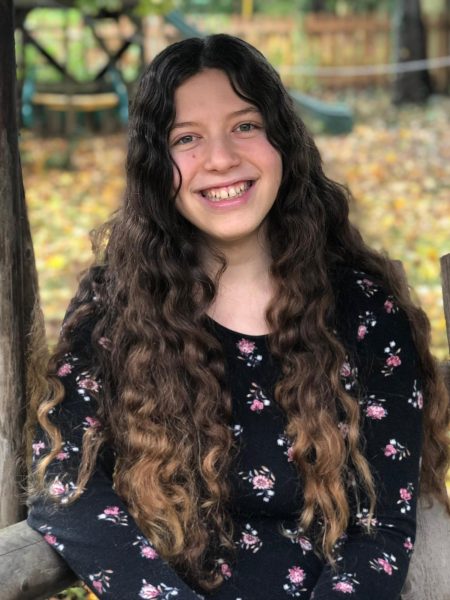
For as long as Shelley Ouyang can remember, she’s been an owl fanatic. She describes her fascination with birds as having originated at birth. As a young child, Ouyang would tape cardboard plates to her arms and jump off her living room couch in a futile attempt to fly like the birds she admired. Now a junior at Pioneer High School in Ann Arbor, Michigan, Ouyang has given up on her dreams of becoming an avian. What she hasn’t lost sight of, though, is her love and appreciation for both the ecological and aesthetic importance of owls and other birds. Nowadays, instead of experimenting with flight, Ouyang’s interest in owls is focused on protecting the increasingly at-risk birds from human-induced threats related to climate change and habitat destruction. Recently, motivated by her enthusiasm for birds, Ouyang researched, planned, built, and installed a nest box in the wild to help make up for the ever-shrinking supply of owl homes in the wild. And with that project under her belt, Ouyang sees her work with habitat conservation, wildlife advocacy, and owl fanaticism as only just beginning.
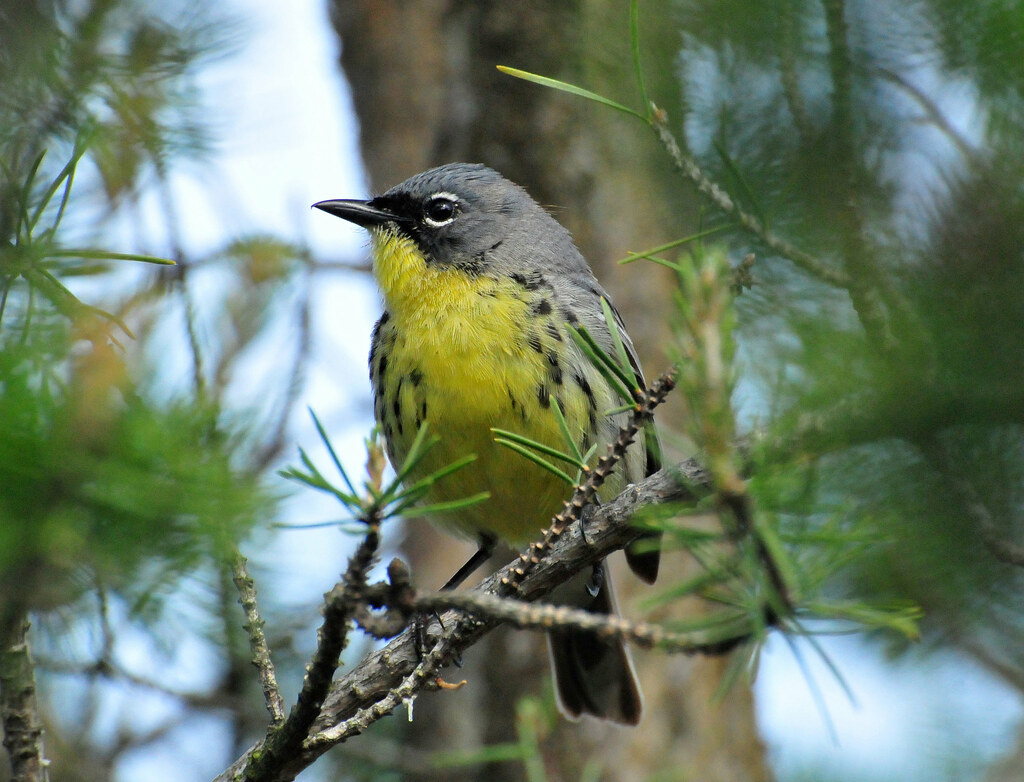
Bird boxes, also called nest boxes, are designed to serve as nesting spaces for birds in the wild. For Ouyang, her focus is on Eastern Screech-Owls, a personal favorite species known for their miniscule size and astonishing camouflage ability. The Eastern Screech-Owl population has been declining in recent years as a result of the removal of the old trees whose cavities the owls depend on for nesting. That’s where Ouyang and other conservationists nationwide come in, creating wooden boxes mimicking the accommodations of those tree cavities. Ouyang describes the bird box she built as a “five star hotel for a bird.”
Shelley Ouyang kicked off her bird box building project in the fall of 2025, prompted by her growing awareness of the threats her beloved birds are facing as a result of habitat destruction. For Ouyang, conservation work isn’t self-aggrandizement or even a response to some profound moral realization. Rather, she feels a simple, logical responsibility to address the damage humans have done and preserve the animals she’s gotten so much joy out of researching and admiring throughout her life. “Owls are freaking cute, and that was literally my biggest motivation,” Ouyang said. “Most birds are facing some kind of threat from us … Like a lot of animals, they are facing habitat loss. A lot of them are super endangered, not Screech-Owls specifically but other owls in America. I think that’s sad, because it’s like having your house bulldozed by naked monkeys.”
Eastern Screech-Owls are an adaptable species, and are able to make themselves comfortable in man-made nest boxes, if those boxes are placed within the owls’ natural habitat. Bird boxes for Eastern Screech-Owls are made to functionally resemble the naturally formed tree cavities the birds seek to live in. The construction and installation of these bird boxes has become increasingly widespread in recent years. Outside of Ouyang’s efforts in Michigan, a broad network of conservationists are building nest boxes in Florida, Maryland, and everywhere in between.
Ouyang kicked off her bird box process with extensive research. “Honestly, most of the research was probably not necessary,” she said. “It was a lot of basic data of what Screech-Owls like to eat, what periods of time … they roost, where you’ll find them, what their habits are like, [whether they are] completely nocturnal. It really just comes down to knowing the area that you’re going to put your box up in and figuring out if it’s suitable.”
After reading countless articles and instruction manuals online, Ouyang contacted local organizations to find wildlife experts to collaborate with. “One of those was Leslie Science & Nature Center, but also some other Washtenaw people who know about birds generally to give me guidance,” Ouyang said. The Leslie Science and Nature Center is an Ann Arbor facility featuring woodland hiking trails, display enclosures for critically injured and rescued raptors, and countless classes and other opportunities for community education on ecology and wildlife. The center played a critical role in Ouyang’s project. Bird life experts there were able to provide Ouyang with details about how best to construct her bird box to adequately serve owls’ needs. “They clarified a bunch of more niche questions for me,” Ouyang recalled.
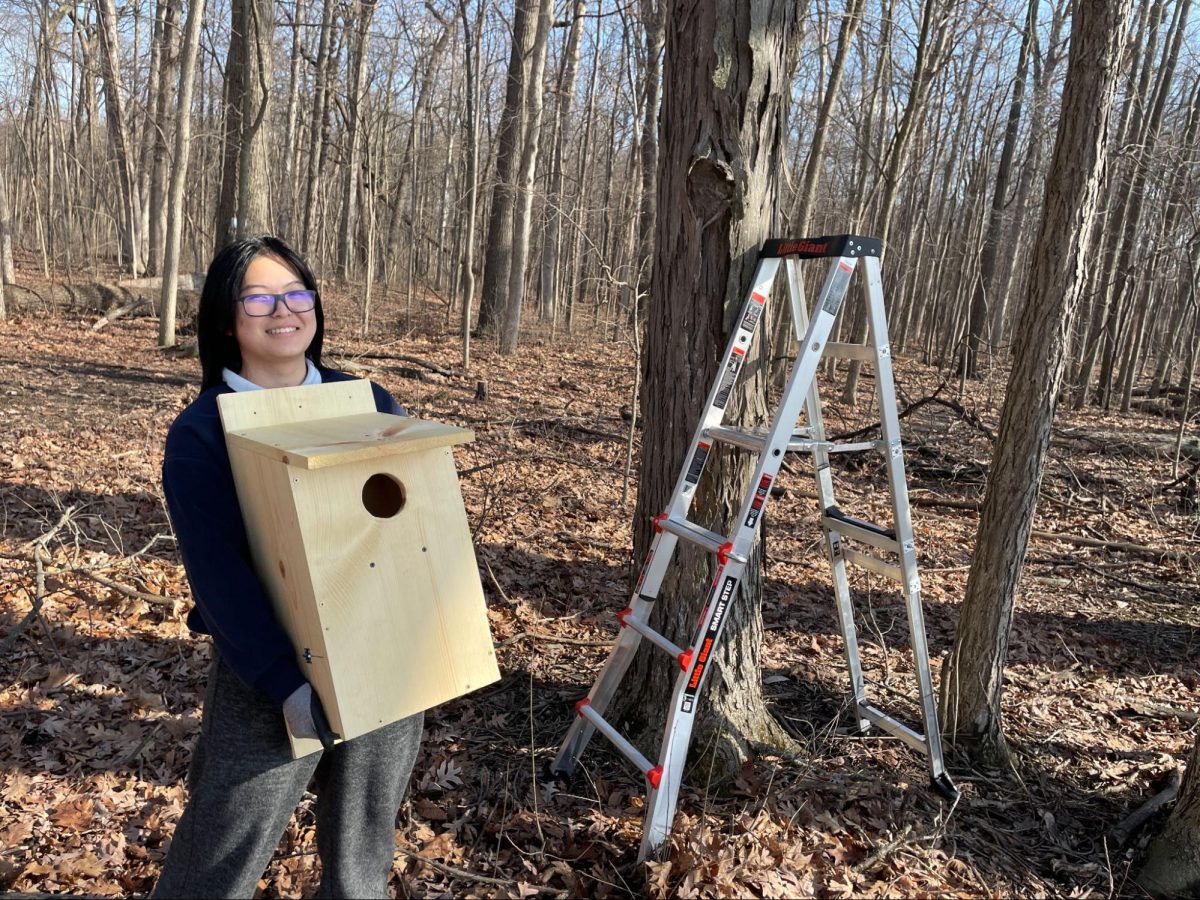
“Then it actually came around to building it, which was two giant wood planks. I used pine, just from Lowe’s,” Ouyang described. “I took them home, cut them up … and then nailed it together and weatherproofed it.” She roughly followed a blueprint and instruction manual from Cornell’s Lab of Ornithology, but also used additional information from the other sources she’d accessed. She designed the box to be sized and located in a way that would be specifically conducive to Eastern Screech-Owls’ needs, but Ouyang hopes that other wildlife will be able to benefit from its placement as well. “If other birds like kestrels or burrowing owls or saw-whet owls or even a squirrel end up using it, it’s all fine.”
Lastly, Ouyang faced the decision of where exactly to place her bird box. Eastern Screech-Owls thrive in woodland habitats near bodies of water. Ann Arbor has many such areas, but most have strict restrictions on the installation of man-made items. “I reached out to two different conservancies,” Ouyang said. “One of them replied to me: Legacy Land Conservancy. We were looking at specifically one of their preserves.”
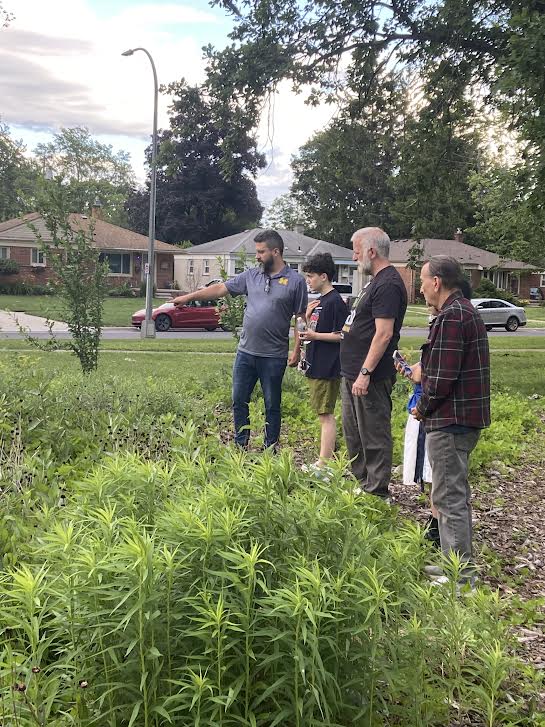
Ouyang communicated directly with the family who owns one of the preserves that make up Legacy Land Conservancy, a Michigan land conservation non-profit. Within a few weeks of her original contact, she was able to visit the preserve in person with her freshly assembled bird box in tow. “I met with one of the guys from the conservancy, went out to the park, picked a tree, nailed it into the tree, and then it was pretty much done.”
What’s only just beginning, though, is Ouyang’s involvement in conservation and environmentalist efforts. While she’s always loved the natural world, she used to doubt her own ability to take part in preserving it. “I kept on being like, ‘I’m a kid, right? I have no agency, I can’t do things for the environment.’ But now I’m like, ‘Well, I’m seventeen, it’s about time, right?’ … I want to do as much volunteering as I can,” Ouyang said. “I want to get more bird boxes out. I definitely still want to continue with this.”
Ouyang didn’t start building bird boxes with an extensive background in activism — or in building, for that matter. She’s not an ecology professional, she’s just a teenager who’s fascinated by learning about and helping out her favorite birds. Ouyang hopes that more teens like herself will be empowered to get involved in local efforts and take a stand in whatever way feels most authentic and achievable for them. “[With] volunteering, there are so many different levels of commitment. [Even] if you are super busy you can probably spare one or two hours one day on a weekend … you don’t have to do a hands-on thing like bird boxes, you can do so much as donating five dollars. It’s never too late, and you’re also never too young to start.”
Protecting the Owls © 2026 by Youth Environmental Press Team is licensed under CC BY-NC-ND 4.0. To view a copy of this license, visit https://creativecommons.org/licenses/by-nc-nd/4.0/